The opening conference of the cross-border project “Environmental Risk Assessment from Mining Activities as a Result of Tailings Storage in the Romania–Serbia Border Area” was held on January 29, in the congress hall of the Iulius Town complex in Timișoara. This project is being implemented under the Interreg IPA Romania–Serbia Programme, with the aim of enhancing environmental protection and improving the management of ecological risks in mining regions of both countries.
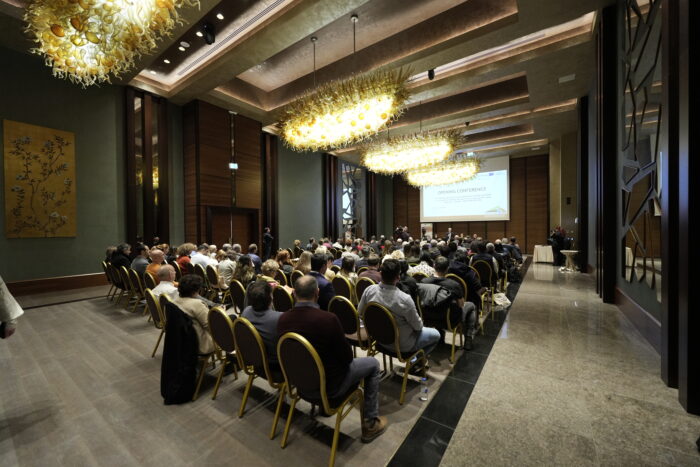
The project is ambitious in scope and has a total value of EUR 1,242,286.25, of which EUR 1,055,943.31 is funded through the IPA III CBC Fund, while the remaining amount is provided by partner institutions. The conference was attended by more than 140 participants, including representatives from the scientific community, local authorities, and the mining industry. The event was opened by PhD Nicoleta Nemeș, the project coordinator, who presented the project’s main objectives and its importance for cross-border cooperation. Opening remarks were also delivered by PhD Liviu Marșavina, Vice-Rector of the Politehnica University of Timișoara, and Ivana Jakšić Matović, Consul General of the Republic of Serbia in Timișoara.
A special focus of the conference was the participation of the Mining and Metallurgy Institute Bor, whose representatives delivered notable presentations on the current state of the mining sector in Serbia and the challenges of managing ecological risks. PhD Daniel Kržanović, the project coordinator on the Serbian side, spoke about the key activities of the Institute within the ERA-MIN project and the importance of international cooperation in environmental protection. MSc Igor Svrkota, Head of the Metallic Mineral Resources Department at the Institute, presented the work and technical capacities of the Institute, emphasizing their contribution to the analysis and assessment of environmental impacts from mining activities. MSc Miloš Stojanović, delivered a presentation titled “Bor and Mining – Challenges and Perspectives”, where he addressed the environmental challenges faced by the Bor District and proposed solutions for improving sustainable mining practices.
The conference concluded with a message highlighting that an interdisciplinary approach, cross-border cooperation, and the implementation of modern technologies are essential for reducing the negative impacts of mining and protecting the environment. The ERA-MIN project, with significant financial support from EU funds, represents an important step in this direction, and the research results and proposed solutions are expected in the upcoming phases of implementation.
Bor as a Hub of Regional Scientific Cooperation within the ERA-MIN Project
On February 27, 2026, the city of Bor hosted an important event dedicated to advancing scientific and professional cooperation in the field of environmental protection and sustainable mining. The event once again highlighted the role of European initiatives in strengthening knowledge, environmental standards, and public safety.
The third workshop of the international project “Environmental risk assessment from mining activities as a result of tailings storage in the cross-border area Romania–Serbia (ERA-MIN_RO-SRB)” was held at the National Library in Bor. The project is supported by the European Union through the IPA Cross-Border Cooperation Programme Romania–Serbia.
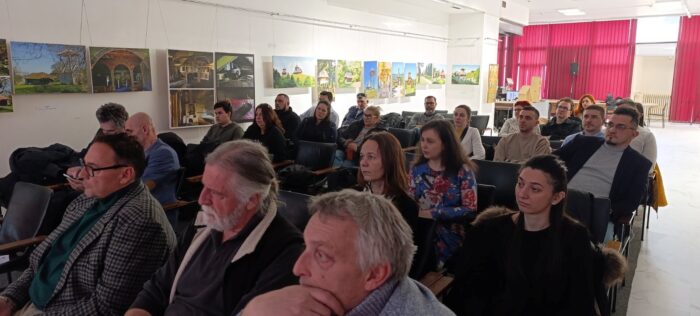
The workshop was opened by Dr. Daniel Kržanović from the Mining and Metallurgy Institute Bor, acting as the project coordinator. In his address, he emphasized the importance of integrating scientific research, institutional cooperation, and social responsibility. He noted that extensive fieldwork, seasonal sampling, and laboratory analyses have already been conducted, and that the project is now entering its final phase, focused on preparing comprehensive studies on environmental and health risk assessment.
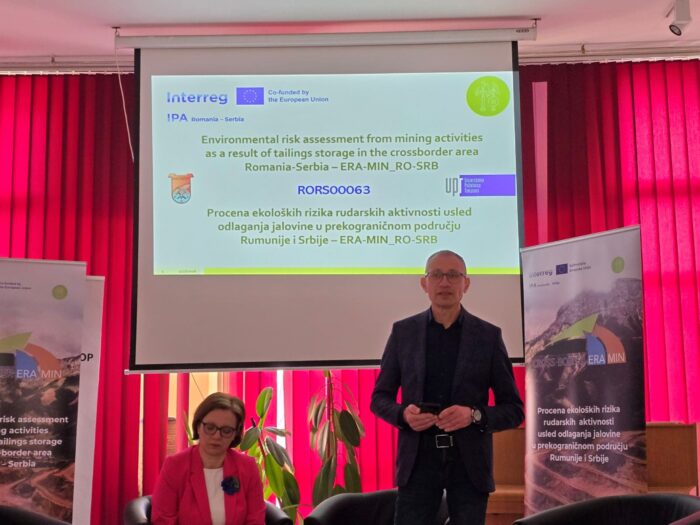
Dr. Nicoleta Nemeș Sorina from the Polytechnic University of Timișoara presented the results of the autumn–winter monitoring campaign, stressing the importance of continuous environmental monitoring and cross-border data exchange, given that environmental issues do not recognize administrative boundaries.
The scientific segment of the program also featured notable contributions from experts in various fields. Miloš Stojanović addressed the topic of mining tailings management, highlighting the need for a systematic approach that includes continuous monitoring and stability assessment of tailings storage facilities. Dr. Dragana Adamović Marković presented the results of the re-evaluation of mining impacts on local watercourses in the Bor area. Her findings indicate a significant reduction in concentrations of copper, iron, and arsenic following the modernization of wastewater treatment systems, confirming the effectiveness of implementing EU-aligned standards.
A particularly notable presentation was delivered by Nick Lucić, an internationally recognized mining expert from Australia, who pointed out that the region is at an important stage of development and that projects like this serve as a model for future international initiatives.
The ERA-MIN_RO-SRB project represents an important step in strengthening research capacities, enhancing cross-border cooperation, and promoting sustainable and responsible mining practices in the Danube region.